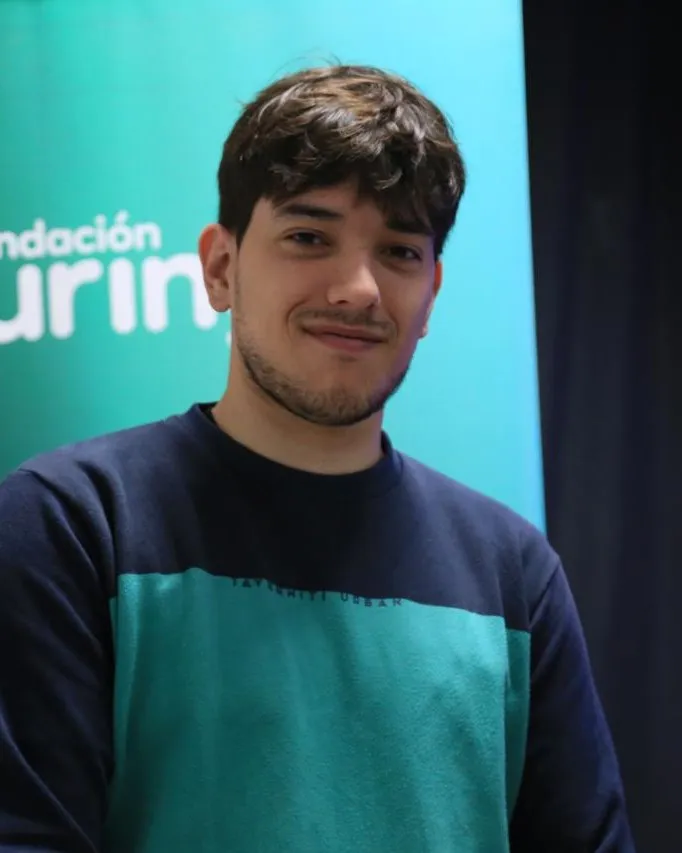
AlvaroDosio

Full stack developer.

Mobile and backend, currently in HealthTech. San Francisco, Córdoba, Argentina. On Saturdays I teach programming at Fundación Turing.

See projectsEmail me

Portrait of Alvaro Dosio

Work

CodeaIT

2024 — now

Full stack developer

Software consultancy. I've moved through projects for different clients, in multidisciplinary teams. Three so far:

  • An Argentine brand of connected health devices. Glucometers, continuous glucose sensors, scales and blood pressure monitors with their own app. Native Expo modules that integrate the manufacturers' SDKs over Bluetooth and keep reading data while the app is in the background. Data analysis screens and AI-assisted glucose reports, built from Figma designs.
  • An AI product-management platform. Web app in React, Next.js and Supabase where non-technical people turn an idea into a structured project by talking to an AI.
  • A platform for families caring for someone at home. HealthTech and FinTech. AWS Amplify integration through native Expo modules, plus a unit and E2E testing strategy in the CI pipelines.
Challenges and achievements (4)
  • SDKs with no support and no docs. The medical device manufacturers offered no React Native support and not enough documentation. I studied the internals of each SDK until the app talked smoothly to the devices, and integrated them through native iOS and Android modules.
  • A sensor that reconnects on its own. The glucose sensor kept dropping its connection. I went through the SDK logs, written in another language, to fix the reconnection logic, and had the app request an exemption from each phone maker's battery optimization, such as Samsung's deep sleep. The connection now recovers by itself, recovers the readings, and alerts keep arriving while the app is in the background.
  • 6,700 readings don't fit in a prompt. The sensor records glucose every 3 minutes: about 6,700 readings per person over 14 days. Instead of sending them all to the AI, I designed a statistical preprocessing step in the backend (percentiles, an AGP profile in 30-minute bins, events and metrics by time of day), and the report is built on that summary together with nutrition, weight and blood pressure.
  • Liveness check without an npm package. AWS Amplify's iOS and Android SDKs had no React Native package. I integrated them with Expo Modules for a low-cost liveness check that compares the face against a reference photo, and it worked end to end.

React Native · Expo Modules · Bluetooth · Next.js · Supabase · AWS Amplify

Fundación Turing

2023 — now

Volunteer, now teacher

After a few years as a volunteer, in 2026 I started teaching Creá tu propia App: 4th and 5th year high-school students who arrive without knowing how to code and leave with a working app, built with block programming, design tools and AI agents. Free, on Saturdays at UTN. I also run workshops at Jornada Ada Lovelace, a Latin American day of STEM workshops for girls aged 10 to 12, held simultaneously at more than a hundred venues; the San Francisco one is organized by the foundation and UTN.

Teaching · Block programming · AI · STEM

fundacionturing.orgadalovelace.net.ar

Vulletic

2022 — 2024

Full stack developer

A company that builds its own electric vehicle chargers and the software around them. I built the backend that talks to the chargers in real time over OCPP and WebSockets, the origin of I Love OCPP. Also the backend of two products in .NET and MongoDB, an internal API in TypeScript, and the Flutter app for Android and iOS with Firebase and Mapbox. I set up CI/CD in Azure DevOps and managed the Linux servers.

Challenges and achievements (3)
  • Every manufacturer, its own OCPP. There's one protocol, but every charger manufacturer implemented it their own way. I worked out the expected behavior with each of them until about 20 chargers were running against the backend.
  • From 20-minute deploys to 2. Deployments were manual: copying files to Windows servers over remote desktop, 15 to 20 minutes and often failing. I replaced them with Azure DevOps CI/CD pipelines that take 1 to 2 minutes.
  • One QR code, many states. The Flutter app, published on the App Store and Google Play and used by about 50 people, starts a charger by scanning its QR code. I built that flow to handle every charger state and rejection, with a clear on-screen message for each case.

.NET · MongoDB · Flutter · OCPP · WebSockets · Azure DevOps

Projects

Thesis · UTN San Francisco

VetClinic

The one thesis from my class that's still running in production.

Read more

Stack

Languages
TypeScriptJavaScriptKotlinC#Dart
Mobile
React NativeFlutterExpo
Backend
NestJS.NETAdonisJSExpressEntity FrameworkKtorWebSockets
Frontend
ReactNext.jsVue 3
Databases
PostgreSQLMySQLSQL ServerMongoDBSQLiteSupabase
CI/CD and DevOps
DockerGitHub ActionsAzure DevOpsEASNginx

Education

University Technical Degree in Programming

2022 — 2025

UTN San Francisco

Technical Degree in Programming

2015 — 2021

ProA Técnica San Francisco

Native Spanish. Advanced, conversational English.

Want to build something that matters?

Drop me a line and let's talk.

dosioalvaromartin@gmail.com